
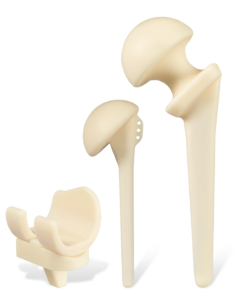
Bone Spacers
Bone spacers are temporary implant devices used primarily in orthopedic revision surgeries, especially in cases involving severe joint infections or bone defects. Made from PMMA bone cement and often infused with antibiotics, these spacers help maintain joint space, preserve soft-tissue tension, and deliver high local concentrations of antimicrobial agents directly to the infected site. Bone spacers function as a crucial bridge between implant removal and re-implantation by stabilizing the joint, reducing pain, and allowing partial mobility during the treatment phase.
There are two main types—static spacers, which immobilize the joint to support healing, and articulating spacers, which mimic joint movement and allow patients to walk more comfortably during recovery. Their design helps prevent soft-tissue contracture, supports alignment, and maintains limb length while infection control takes place.
By combining mechanical support with targeted antibiotic delivery, bone spacers significantly improve outcomes in two-stage revision arthroplasty and complex orthopedic reconstructions. They play an essential role in restoring joint function and enabling safe, effective re-implantation once infection has been cleared.